Why you should trust us
This is our sixth year recommending window air conditioners, and my fourth year on this beat, personally. We've put in about 115 total hours of research and spent more than 40 hours doing real-world testing, along with more than 1,000 hours of being cooled off by the models we've recommended. Our expert sources include a representative for the Environmental Protection Agency, which administers the Energy Star program, as well as Max Sherman, an HVAC+R (heating, ventilation, air conditioning, and refrigeration) engineer who works as a staff senior scientist at Lawrence Berkeley National Laboratory.
The right air conditioner size for you
Measure the square footage of the room you need to cool, then look at this Energy Star chart to find the appropriate cooling capacity, as measured in British thermal units (Btu). Sun exposure, ceiling height, appliance heat, and the number of people that'll usually be in the room can impact the capacity you'll need, but floor size is the most important factor. You won't always be able to find an AC with the perfect Btu rating, so you might have to round up. For example, nobody makes a 9,000 Btu window AC, so a 10,000 Btu window AC is the next-best option in that case.
Don't fall into the trap of buying a significantly under- or overpowered air conditioner. Smaller units cost less, so you may be tempted to size down if you're looking to save a few bucks. But an underpowered AC will run constantly, trying and failing to get the room down to the target temperature and a comfortable humidity. That's a waste of energy, and you won't even be that comfortable. If you get a unit that's too big, it can leave your room feeling clammy because it reduces temperature faster than it removes moisture from the air. "It's going to cycle on and off more, and then you're going to lose some of your humidity control," said Sherman.
Need to cool multiple rooms? It's more effective to get several smaller air conditioners and put one in each room, rather than to buy one big unit. When two rooms are separated by a doorway, they're "thermally separated," as Sherman put it. That means an AC in your living room won't do much to cool your bedroom. Sure, you'll have to spend more money to buy two 6,000 Btu ACs than you would to just get a 12,000 Btu AC. But you get much more accurate, comfortable climate control when you use the right machine for each room.
How we picked

The air conditioners we tested in 2017. Note: Stacking them in this way does not constitute a proper installation. Photo: Liam McCabe
The best window air conditioner makes you the most comfortable in your home. For most people, that means picking a quiet AC without jarring whines, whooshes, or whirs, and with as much control over climate settings and air direction as possible. Ideally, the best air conditioner will pass the bedroom test: If it's good enough to sleep near, it's good enough for any other room in your house.
Everything else is much less important. Installation and maintenance should be easy, but they don't vary too much from model to model, and you have to deal with them only a couple times per year. And cooling power and energy efficiency are so, so similar for window ACs at a given Btu rating that it's barely worth worrying about. When comparing models, the difference in reaching a target temperature is never more than a few minutes, and the difference in an annual cost to operate is never more than a few dollars.
For this guide, we focused on 8,000 Btu window air conditioners because it's the most popular size at retail, which implies that it's what most people need. These ACs are suited for spaces between 300 and 350 square feet, roughly the size of a comfy living room or large master bedroom. (Sticking to a common Btu rating also helped us make apples-to-apples comparisons between our top contenders.) Air conditioners at this size can cost anywhere from $180 to $730, but you can get a good-enough model for $220 on sale, and the best model you'd reasonably want costs around $370.
If you're looking to cool a larger or smaller room than the average, most of our picks are available in several different sizes. We didn't consider the other sizes, but we're pretty confident that our findings hold up for models between 6,000 and 12,000 Btu.
How we tested

Video: Liam McCabe
In 2017, we began our testing by tracking down about 45 current-model window air conditioners with that cooling capacity. Based on specs, features, price, and our experience with older versions of some models, we settled on eight finalists, split into three subgroups.
The first group is just standard, affordable, Energy Star–qualified window units, including the LG LW8016ER, our top pick from 2016; the Frigidaire FFRE0833S1, our runner-up from 2016; and the newer GE AHM08LW.
The next group is made up of quieter models, including the Friedrich Chill CP08G10B, one of our upgrade picks from 2016; the Haier Serenity Series ESAQ406T, a 6,000 Btu model; and the Frigidaire Gallery FGRQ08L3T1, our upgrade pick from 2017.
Finally, the smart ACs, which have Wi-Fi antennas that let them work with smartphone apps or other smart-home systems: the GE AEC08LW, which works with an app as well as Alexa, and the LG LW8017ERSM, which is essentially our main pick but with app control.
Among those finalists, we focused on noise as the primary distinguishing factor. Window air conditioners can be pretty damn loud these days, louder than they used to be. Some people find that the hum of the compressor and whoosh of the fan make it difficult to sleep in the same room as a window AC. If it's in a living room, expect to raise your voice and turn up the TV. According to this Energy Star memo (PDF; page 2), manufacturers claim that this volume creep is a side effect of stricter efficiency standards. (That's probably true, though it's also a time-honored tradition for industry groups to drag their feet and whine about regulations.) But some models are easier on the ears than others, and we heavily favored air conditioners with a lower operating volume and a smoother frequency response.
We developed our noise test with the help of audiovisual expert and Wirecutter contributor Geoff Morrison. We connected a calibrated microphone to an iPhone 5S, then fired up the SPLnFFT noise meter app, setting it to C-weighting with a slow response. We stood 6 feet away from each unit and measured volume at the low, medium, and high fan settings, with and without the compressor running. During that testing, we made note of any frequency spikes, which your ears would hear as irritating, high-pitched whining, or the kind of midrange whooshing that you don't even realize is giving you a headache until it stops running.
The other way we judged our finalists was the level (and quality) of user control they allowed. One important area where window ACs can differ is their fan vents, which control the direction of airflow. If you sleep near your AC, you'll usually want to be able to point the cold air away from your body, or at least away from your head. But some models have blind spots where airflow can either never reach or always reaches. We also considered the number of fan speeds, extra cooling modes, and the depth of remote control—including any smart, Wi-Fi–controlled features.
Our pick: LG LW8016ER
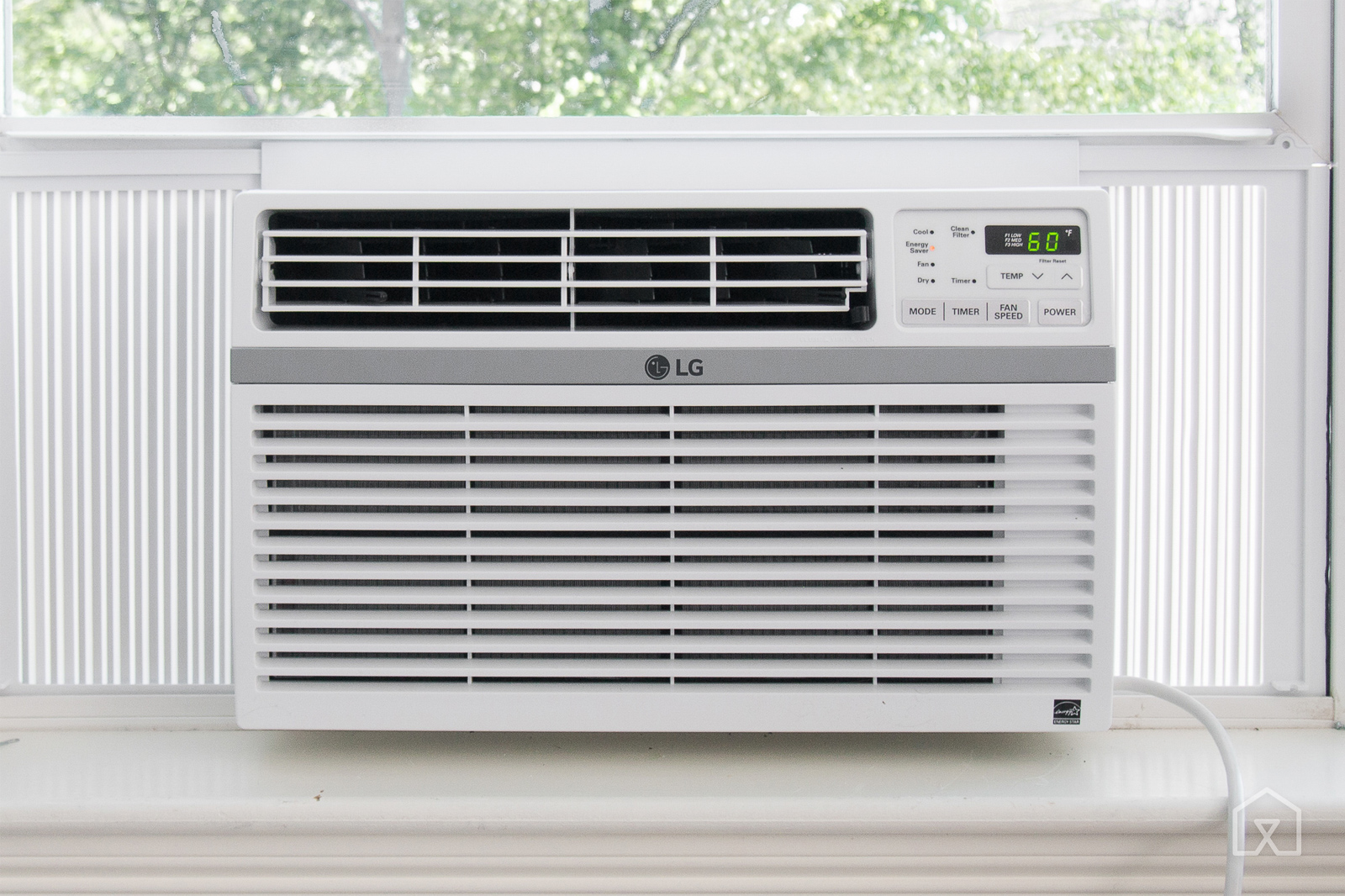
The LG LW8016ER is the best affordable AC for a home office or living area because it's quietish, gives you more control than others, and tends to cost less than its competition. Photo: Liam McCabe
The LG LW8016ER is the window AC you should probably get, especially if it's for an office, den, or other room where you won't be sleeping. For some people, it'll be fine in a bedroom, too. It's widely available and the price is fair, so you shouldn't have any trouble finding it on short notice—for instance, in the middle of a heat wave, which is when you're probably reading this article. Compared with other ACs at this price, it's quieter and hums along at a lower pitch, so it's easier on the ears. And though AC controls aren't rocket science, this one offers a greater level of flexibility in total than most of its competitors, covering all the little details, from the fan's directional controls and outdoor-air vent to the dehumidifier mode and removable drain plug. This is the second summer in a row that we've recommended the LW8016ER as our top pick.
Most air conditioners are loud, but the LW8016ER is the least-worst of the $250-ish, 8,000 Btu window ACs. It's a bit quieter overall and sounds lower-pitched. At its absolute loudest, with the compressor on and the fan at full speed, we measured it running at 66 dBC (that is the C-weighted decibel scale). At the slowest fan setting and with the compressor on we measured about 62 dBC. The lowest fan-only (no-cool) setting is about 60 dBC. Relative to our runner-up pick, that's about 1 dBC quieter in cooling modes, and 3 dBC quieter in fan-only mode.
Although the overall volume is not much quieter than competing models, the LW8016ER will probably sound quieter to most people. That's because it's loudest at low frequencies, peaking around 86 hertz in our tests, and quieter at mid and high frequencies. That means the most prominent sound it makes is a deep hum. It's almost (almost) relaxing. Compared with other models around 1,500 and 2,000 hertz—the kind of midrange, "whooshy" frequencies that can wear your ears down after a few hours—it's relatively quiet. We didn't notice any high-frequency spikes, either, which are the kinds of irritating, whiny noises that most people can't stand for even a few minutes. That all adds up to mean this AC is easier on the ears than its closest-priced competitors—even if it's still a little louder overall than most of us would like.
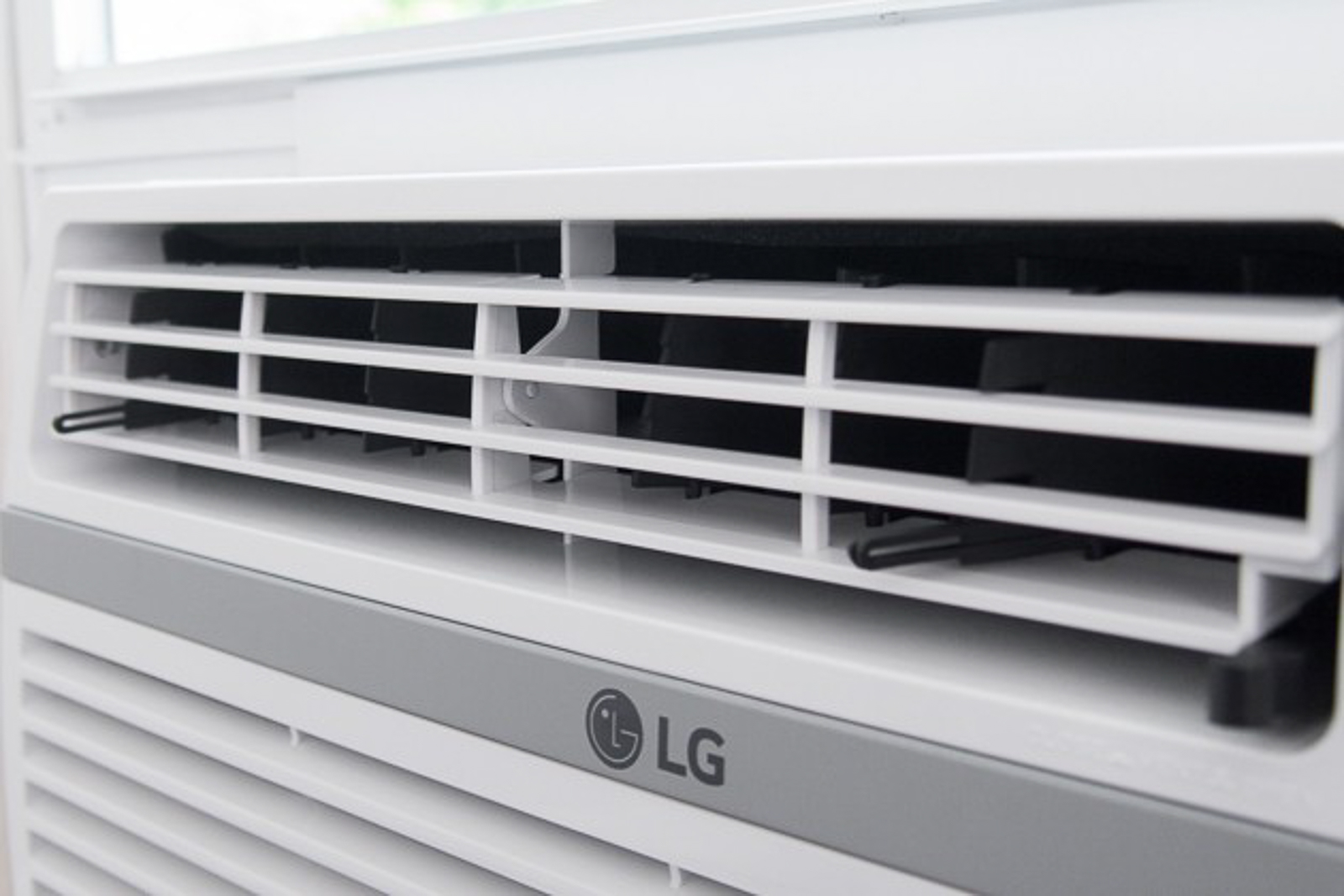
The LW8016ER has fan blades that are as effective as any AC's at directing air exactly where you want it to go. It's one example of the superior control that this AC offers. Photo: Liam McCabe
The LW8016ER also offers extra controls that seem really minor, but can make a huge difference. For example, the fan blades are as effective as any at directing air where you'd like it to go, and stop it from going where you wouldn't. That can come in handy if you sleep near the AC, so you can direct the cold air away from your head at night. Some window units struggle with fan direction and have cold spots where they can't stop blowing air—not a problem with the LG.
The LW8016ER also has a removable drain plug on the backside of the unit, a handy feature for humid climates. This lets condensed water flow out of the base of the unit when too much builds up, as can happen when it's very humid and the AC needs to run for hours and hours on end. Having some condensed water in the base of the AC can be good, because it helps improve efficiency. The air-circulating fan has special "slinger" tips that skim the top of the puddle and splash a little water onto the condenser coils to help cool them off faster. But when it's very humid, the puddle gets deeper and the fan starts to make the flickering or bubbling sound, sort of like a water fountain. Some ACs don't have this drain, so the water stays trapped inside the AC until you manually tilt it to drain it. Others situate the drain plug on the bottom, where it's much harder to reach without uninstalling the whole unit.
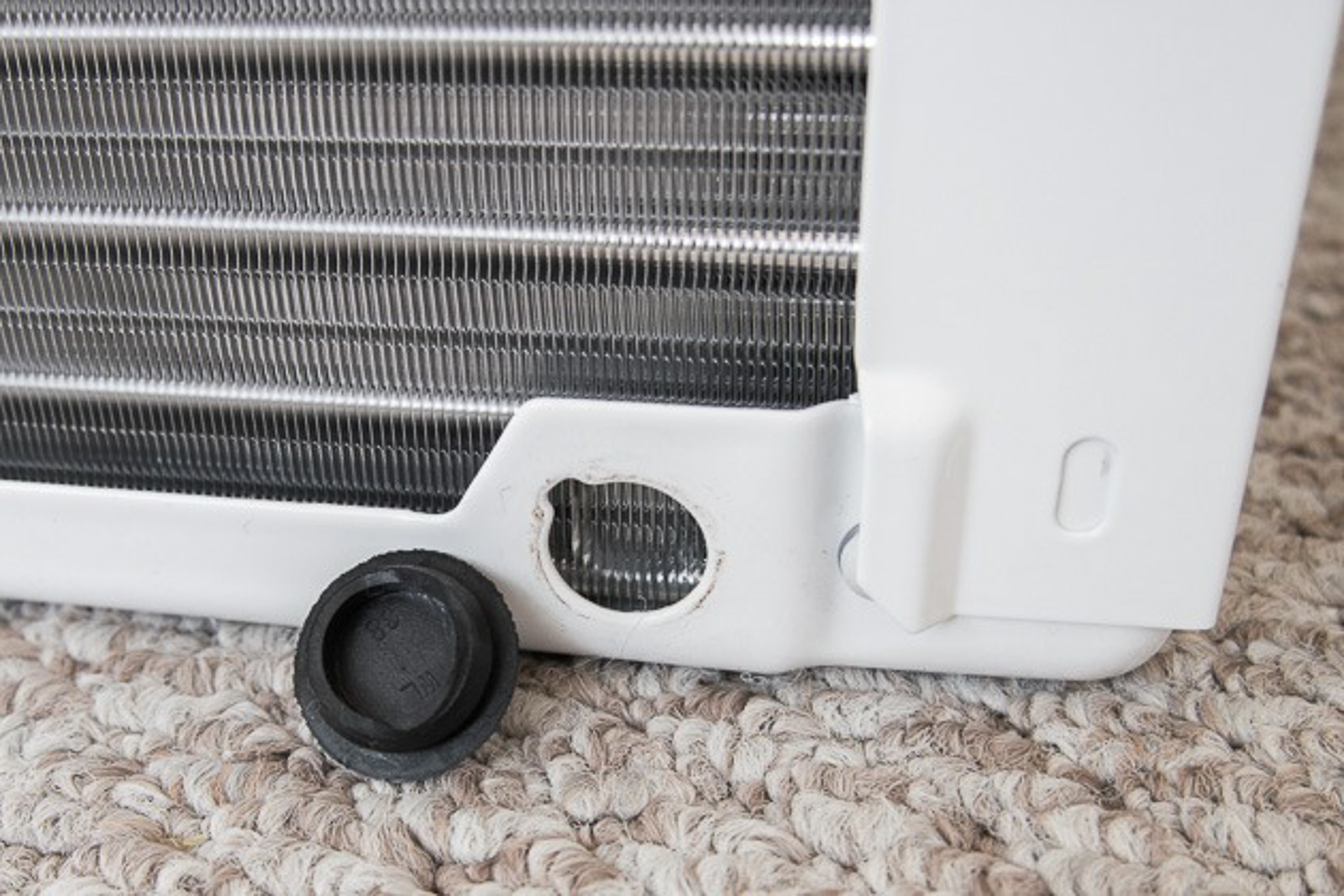
If too much condensed water pools in the bottom of the LW8016ER, like it might in a very humid climate, you can pull out this plug and let the water drain out. That'll prevent any of those irritating flickering noises caused by the fan spinning through a puddle. Photo: Liam McCabe
Unlike most window ACs, the LW8016ER also has a vent that can mix in about 10 percent fresh, outdoor air, if you choose to open it. It's a good idea to get new air into your home from time to time, so if you can't open the window while the AC is installed, this is a fine workaround.
The LW8016ER model also has a dedicated dehumidifier mode, which might find some use on those afternoons in early fall when it's too chilly to run the AC, but muggy enough that you want some relief. Some window ACs have it, some don't.
The LG also has all the other basic features that most of us have come to expect from a window AC: An installation kit, a digital thermostat, a remote control, three fan speeds, some foam strips to stuff the gaps around the unit, some foam board to install over the accordion curtains, an energy-saver mode where both the cooling unit and the fan turn off once the room reaches the target temp, and a 24-hour on-off timer.
The LW8016ER uses a different refrigerant than most ACs, and though it didn't factor into our decision, we think it's worth pointing out. R32 refrigerant is ever-so-slightly more efficient than the typical R410A refrigerant, and manifests as about $1 per year in energy savings compared with most other 8,000 Btu Energy Star window ACs. It's not much, but it's something. Also, R32 is rated to have a much lower global warming potential than R410A. So in the unlikely case that the refrigerant leaks out of your AC and gets into the atmosphere, it'll trap only about one-third as much heat. R32 is mildly flammable, but it's been found to be a low safety risk.
As we mentioned earlier, you'll get the best results when you buy an air conditioner with the right Btu rating for the space you want to cool. We specifically tested the 8,000 Btu variant, though others are available from 5,000 Btu up to 24,500 Btu. (The 5,000 Btu model looks like a crappy little air conditioner, so we'd recommend stepping right up to the 6,000 Btu unit if your room is that small.) Here's a cheat sheet to help you find the right size:
| Room size (square feet) |
Btu |
Model |
Notes |
| 100 to 150 |
5,000 |
LW5016 |
No remote no, digital thermostat |
| 150 to 250 |
6,000 |
LW6016R |
|
| 300 to 350 |
8,000 |
LW8016ER |
Our pick |
| 350 to 450 |
10,000 |
LW1016ER |
|
| 450 to 550 |
12,000 |
LW1216ER |
|
| ~800 |
15,000 |
LW1516ER |
|
| ~1,000 |
18,000 |
LW1816ER |
230 volts required |
| ~1,250 |
24500 |
LW2516ER |
230 volts required |
LG released a variant of the LW8016ER for summer 2017, known as LW8016ERY7. According to a representative from LG, this variant is an "engineering revision" but "doesn't affect operating volume, performance, noise, efficiency," or other noticeable factors. You probably won't even notice this new variant in stores, because it will just be sold as the regular LW8016ER. We are confident that both versions perform similarly, though we'll keep an eye out this summer for user reviews that point out new problems. Revisions like this are a fairly common practice in the appliance industry when models are available for several years; changes in the supply chain can force manufacturers to use a different pump or fan during different production runs, for example. LG did not mention what exactly changed here, but we're not too worried about it.
Flaws but not dealbreakers
It bears repeating that the LW8016ER is not quiet, it's just quieter than other window air conditioners at its price. We imagine plenty of people will have some trouble sleeping in the same room as this thing. If you're putting an AC in your bedroom and are worried about noise, take a look at our upgrade pick, the Frigidaire Gallery FGRQ08L3T1.
The LW8016ER was the most cumbersome to install of all the window units we tested, but only modestly so. The worst part is that the weight is lopsided toward the back of the unit, so it feels slightly more treacherous to seat on a windowsill. It's 58 pounds, which is heavy but only 10 pounds heavier than the lightest model we installed. Another nitpicky, moderately annoying detail: The side curtains screw in, whereas those of most other units slide in. That said, you'll have to deal with installation only once each spring and once each fall, so it's not a huge deal. Enlist a buddy, use a support bracket, and installation will be fine.
The remote control that comes with the LW8016ER is pretty basic, compared with those of other ACs, with no screen and only six buttons. That's not necessarily a bad thing, because the simpler interface means it can run on a single AAA battery rather than a pair. Plus, some people prefer a stripped-down control scheme.
Consumer Reports puts the LW8016ER pretty low in its rankings, mainly for poor noise scores (worse than previous versions of the LG AC, which are still listed in the rankings at the time of writing). According to our measurements, however, this year's LG runs at just about the same volume as previous versions did. We're not sure how they came up with this result.
Runner-up pick: Frigidaire FFRE0833S1

A close look at the fan blades on the Frigidaire, a solid window unit that's a bit loud compared with the units we've found this year. Photo: Liam McCabe
If our main pick is unavailable, the Frigidaire FFRE0833S1 is another affordable, widely available window AC. On cooling performance, the FFRE0833S1 works just like our main pick, and its price is also often similar.
But it's not our top choice for a couple of reasons. First, it runs slightly louder (63 dBC on the lowest fan setting, and 67 dBC on the max setting) and with a more noticeable, higher-pitched whine. You'll have to raise your voice and turn up the TV just that much more, and it'll be a greater struggle to fall asleep near this thing.
Some little user-control features are lacking, too. The disc-shaped fan blades on the FFRE0833S1 permanently blow at least some air toward the right side of the unit, even if you direct most of it to the left. That can be annoying if it's near your bed, blowing cold air on your neck all night. It also doesn't have a drain, so in very humid conditions it can start to make an obnoxious flickering, bubbling noise as the fan passes through the pool of condensed water built up in the baseplate. You'll need to manually tilt the unit to drain it to make the noise stop if that happens to you.
In its favor, though, the Frigidaire FFRE0833S1 is easier to install than our main pick. It's 10 pounds lighter, with a smaller chassis and a more-centered weight distribution. Also, its side curtains slide in, rather than screw in, saving a few minutes of work and frustration.
The FFRE0833S1 also has a feature-heavy remote control, including a built-in thermostat and a basic screen. The idea is that with the "remote sensing" mode enabled, the AC will keep running until the air near the remote (which could be on the opposite side of the room from the AC unit) reaches the target temperature, rather than the air near the AC itself. That said, we've tested multiple versions of this remote over the last few years and it's always been wildly inaccurate. The calibration is way off, by about four degrees compared with the main unit. Other users shared similar experiences. But the remote didn't influence our pick one way or the other.
Pricewise, our main pick and runner-up can jump all over the place, from day to day. However, every summer that we've paid attention, we've seen prices for the Frigidaire and LG models settle around $220 by mid-summer and drop as low as $200 at times. Keep your eyes peeled for deals.
Like the LG LWxx16ER, the Frigidaire FFRExx33S1 is available in many different Btu ratings, from 5,000 to 22,000. It may also be available in "store exclusive" packages, with a slightly different SKU (it will have a "B" for the Best Buy version and an "L" for the Lowe's version). Generally, the remote control is the only difference.
Upgrade pick: Frigidaire Gallery FGRQ08L3T1
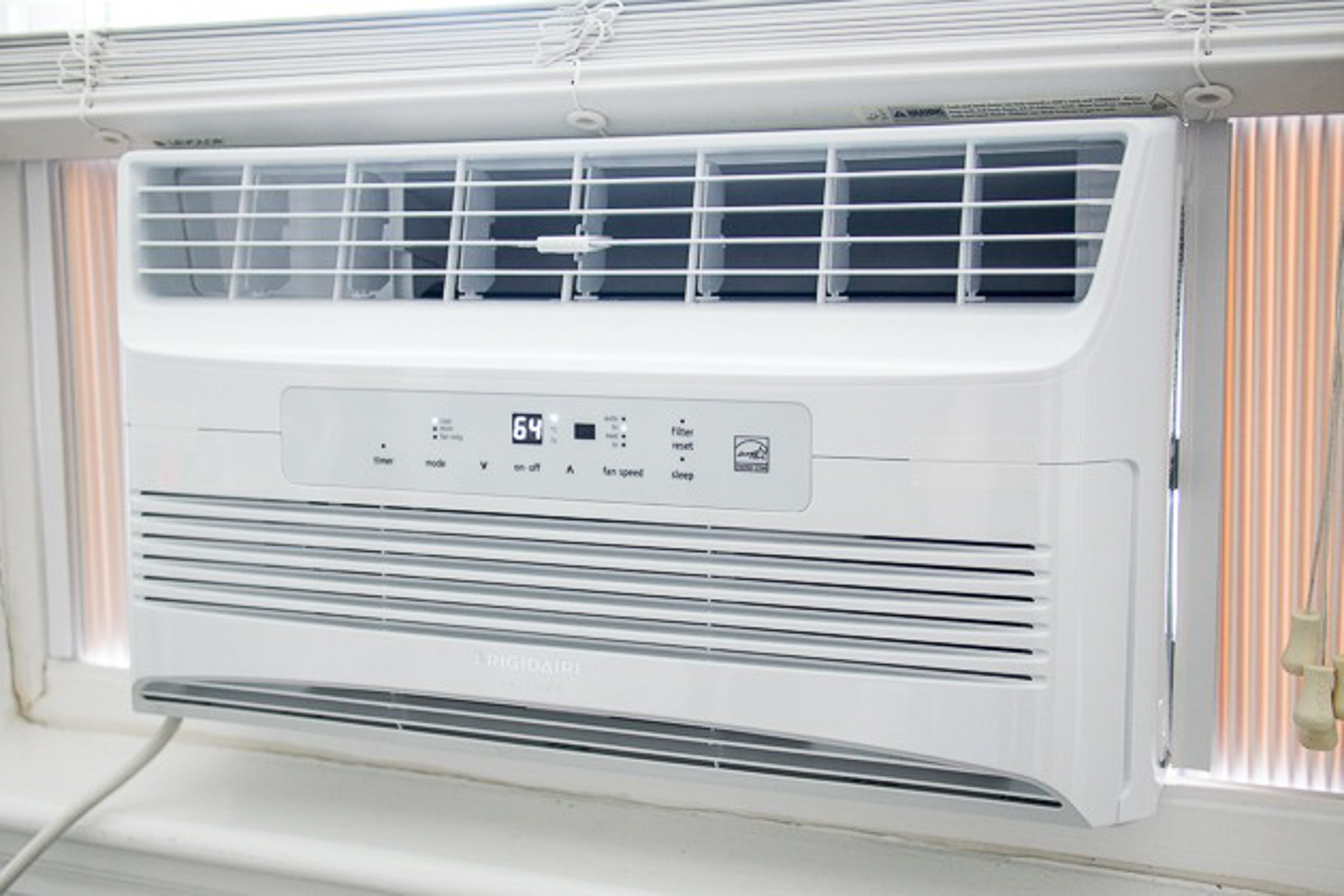
Photo: Liam McCabe
If you're installing an air conditioner in your bedroom, or if you just value peace and quiet in any other room, treat yourself to the (relatively) hushed performance of the Frigidaire Gallery FGRQ08L3T1. It usually costs $50 to $80 more than our main pick or our runner-up, but it runs very quietly, and you'll sleep better all summer. It can be hard to find, though; fortunately, Frigidaire makes a very similar alternative, the FGRQ0833U1.
At its lowest fan setting and with the cooling mode turned on, the Frigidaire FGRQ08L3T1 runs at just 54 dBC. That's 8 dBC quieter than our main pick, a very obvious difference. At the high fan setting, the FGRQ08L3T1 is also at least 6 dBC quieter than any other run-of-the-mill window AC. Our tests didn't register any annoying frequency spikes, either. This model isn't silent, but if you can fall asleep while you watch TV, you can fall asleep near this air conditioner.
The FGRQ08L3T1 comes with an excellent installation kit, including slide-in curtains, plenty of foam strips to stuff window gaps, foam tape to cushion the edges of the brackets, foam boards to further insulate the accordion curtains if you choose, and screw-in brackets to securely attach the AC to the window frame. It's also a few pounds lighter than our main pick, and the weight is centered, so it's a little less harrowing to install.
Most of the modes on the FGRQ08L3T1 are pretty typical: three fan speeds, cooling mode, energy-saver mode, fan-only mode, a timer. The remote is pretty basic but looks sleek.
This AC is available in an 8,000 Btu version (FGRQ08L3T1) and a 6,000 Btu version (FGRQ06L3T1). As for cooling performance and energy efficiency, expect them to be about equal to our main pick and runner-up. Like we said, window ACs are so closely regulated that performance and energy use are very similar across the board.
The only real drawback to the Frigidaire Gallery FGRQ08L3T1 is the price: It just costs more than most other window ACs. We're also slightly concerned about availability. It's exclusive to Lowe's, which is a perfectly good retailer—but we've learned over the years that when ACs are available through only one source, they're often hard to find by midsummer. We'll update this guide if we see consistent availability problems over the next few months.
And in the meantime, if you're really having a hard time finding one of our picks, the FGRQ0833U1 is nearly identical to the FGRQ08L3T1, according to Frigidaire. The 33U1 costs roughly $50 more, and we haven't tested it ourselves, but Frigidaire told us that both models are 8,000 Btu, they have the same energy-efficiency rating, and they're both designed to cool rooms up to 350 square feet. If we were buying an air conditioner this summer, and couldn't get our hands on any of our other picks, this is the one we'd buy.
Also great: Haier Serenity Series ESAQ406T
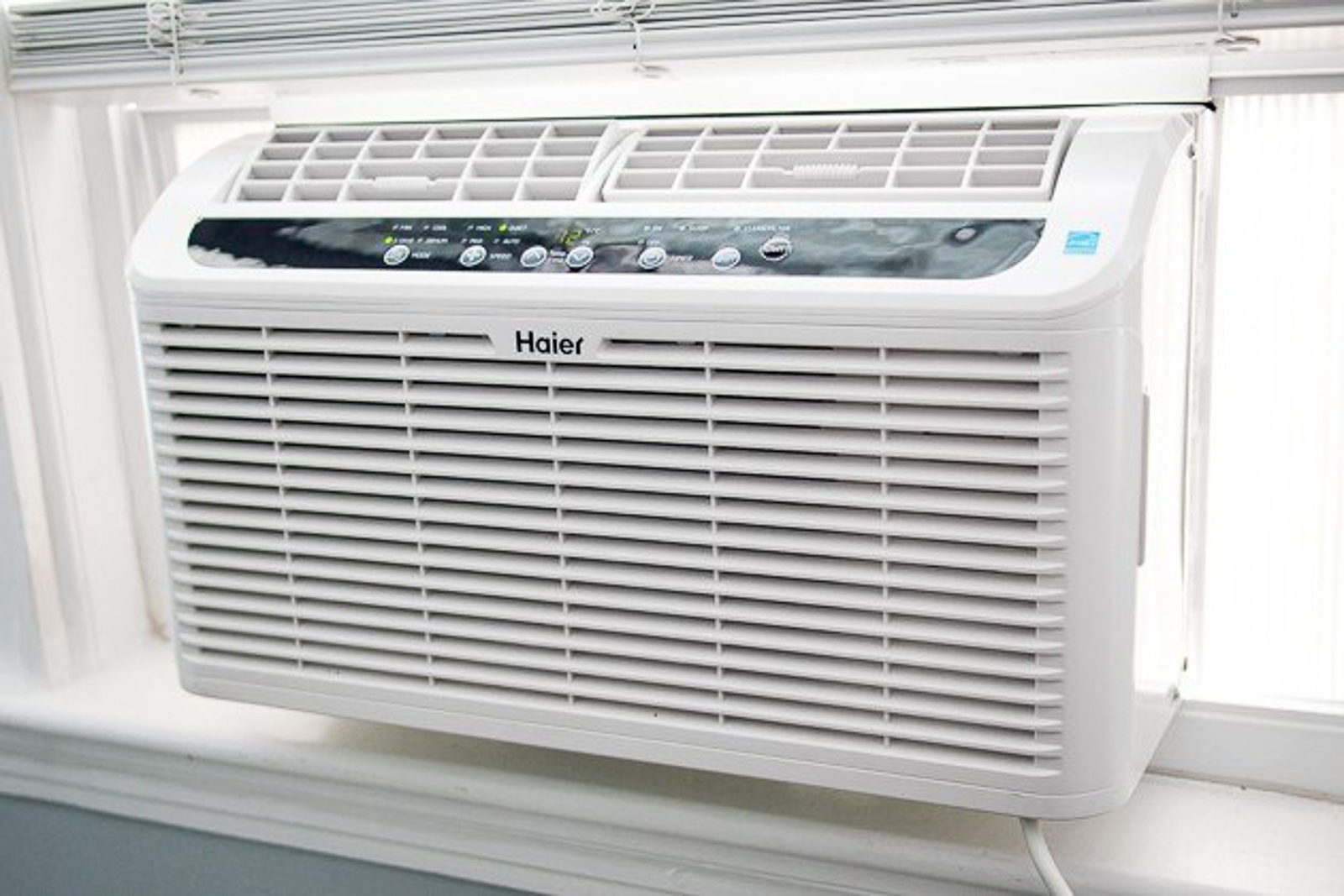
The Haier Serenity Series ESAQ406T runs much quieter than our main pick or runner-up, though at 6,000 Btu, it's meant for smaller rooms. Photo: Liam McCabe
Our favorite bedroom AC, the Frigidaire Gallery FGRQ08L3T1, has been hard for some readers to find in 2018. Both the manufacturers and retailers have told us (this year and in the past) that inventory on these seasonal items varies by region. If you can't find our Frigidaire pick in your area, or if it goes out of stock online, we recommend the Haier Serenity Series ESAQ406T in its place.
The caveats: The Haier model is available in only a 6,000 Btu version—it's suited for rooms smaller than 300 square feet. That should be fine for most city bedrooms, but double-check your measurements before you buy. It also tends to be more expensive than the Frigidaire model. Last, like many air conditioners, its availability is inconsistent from store to store and in different regions, but it was in stock on Amazon as of May 2018.
At its lowest fan setting and with the cooling mode turned on, the Haier ESAQ406T runs at just 54.5 dBC. It's just about the quietest AC you can get—ever so slightly louder than the Frigidaire Gallery FGRQ08L3T1 that we prefer.
As for cooling performance and energy efficiency, the ESAQ406T is a 6,000 Btu model, so it's weaker than our other picks, as well as slightly less efficient with an EER of 11.2 (down from 12.1). However, because window ACs are so tightly regulated by the Department of Energy, we're confident that it will perform similarly to the 6,000 Btu variants of our other picks.
Although the ESAQ406T is relatively quiet, it's definitely not silent, and it may still be too loud for light sleepers. Just as with any air conditioner, the compressor kicks a little when it starts up. The compressor also hums a bit more than those of other bedroom-oriented units we tested this year, though that kind of low-frequency sound can be soothing for some people. If you can't sleep near this thing, you probably won't be able to sleep near any air conditioner. Try earplugs.
This model's fan is angled upward, so it can't blow cold air directly at you while you're lying in bed. This limitation bothers some people.
Installation can feel a little scary, because the weight is skewed to the back corner of the unit, which means this AC doesn't balance on a window frame as easily as some others. It's also pretty heavy for its size, about the same weight as our 8,000 Btu main pick. Ask a buddy to help out if this makes you nervous.
As with many other specific models of hard-to-find air conditioners, the Haier Serenity Series is subject to a lot of local inventory circumstances that may make availability inconsistent.
The competition
The 8,000 Btu Friedrich Chill CP08G10B is our former upgrade pick for the latter part of summer 2016. The ACs in this series are louder, larger, and more expensive than the 2017 Frigidaire or Haier models. On top of that, the packaging is not as sturdy, so they are also more prone to arriving damaged. However, they are widely available, and they come in a wider range of sizes, from 5,000 Btu up to 24,000 Btu.
The GE AHM08LW is louder than our main pick by 2 dBC at the highest fan setting, with more of a midrange "whoosh," so we think it'll be harder to sit near for prolonged periods. It often costs more than our main pick, too (though at ABT it's usually cheaper). Not a bad AC, but not one of our picks either.
Some older versions of our top picks are still floating around, namely the LG LWxx15ER and Frigidaire FFRExx33Q1, which are both from the 2015 cooling season. They each use about 5 percent more energy than their newer versions (at least by Department of Energy estimates), which is a good enough reason to choose the latest models, in our opinion.
Sears sells some Kenmore-branded air conditioners. They're just rebadged versions of Frigidaire ACs, so the same conclusions apply.
We also found about a dozen air conditioners that are carbon copies of each other—all identical machines manufactured by Midea and sold under brands like Danby, Arctic King, Kool King, Comfort Aire, and others you've probably never heard of. We considered testing one, but we know that older versions of this AC tended to be loud, and the current efficiency standards probably mean that the new models are even louder. Plus, they're not available through most of the major big-box stores and Internet retailers.
Smart air conditioners
If you want to control your air conditioner from a smartphone—to get the cold air cranking in your apartment while you're still on your way home from work, for example—you have some options.
The simplest way to do it is to rig up a regular dumb digital AC to a smart plug like the Belkin WeMo. That will let you turn the AC on or off from a smartphone app, or with Alexa voice commands. You won't be able to adjust the temperature or fan settings, but most people who have this setup seem comfortable with that limitation. Check to see if your electric company is giving away smart plugs, like this Con Edison program in New York City.
For more control, your options in the past have not been very good. We've tested just about every smart (Wi-Fi–connected) AC model that has ever been available in the US, and we've yet to find one that works reliably. However, this is a growing field, and we are interested in testing one of several new GE models announced in spring 2018, which we describe in a bit more detail in What to look forward to.
The Frigidaire Gallery Cool Connect FGRC0844S1, for example, seemed decent when we first tested it in summer 2016. It's a relatively quiet, good-looking unit, and the companion app looks slick and responded quickly to us—at first. But after a few weeks, the app started tossing up error messages every couple of days, asking us to reconnect the AC to our Wi-Fi network. Since we constantly had to reset the machine, the scheduling feature didn't work very well. We also think that on one occasion, the AC turned itself on, unprompted; however, that also could have been a very delayed response to an app command that we'd forgotten about from hours or days earlier. Our long-term tester gave up on trying to use the app after a couple of weeks. Owner reviews commonly cite these same problems, and the average customer rating is mediocre.
We ran into similar problems with the old Quirky Aros back in 2014, as well as with the GE AEC08LW (since discontinued) in 2017.
True story: I had just finished writing a cautious recommendation of the AEC08LW, for people who really, really wanted a smart AC. It seemed to be the most stable, responsive model we'd tested. It works with both Alexa and Google Home voice assistants, which is neat, and the iPhone app is pretty slick and user friendly. Owner reviews haven't complained about poor connectivity, either (though this model hardly has any reviews at all).
I had just finished writing up the recommendation. As I walked out of my office, where the AEC08LW is set up, I told Alexa to turn the unit off. Alexa said okay, but nothing happened. I waited a minute, and then tried the voice command two more times—nothing. I opened the iPhone app, which said the AC was already off. I tried to cycle the power, to adjust the temperature and fan speeds—still nothing. Hilarious! I sat back down at my desk to rewrite, and about 10 minutes later, the AEC08LW turned itself off and on four times. Cool. Did I mention this is also the loudest AC we tested that year?
We've also been testing the new LG LW8017ERSM, which is essentially our main pick with a Wi-Fi antenna. It's a quieter air conditioner than the GE AEC08LW, but the connectivity is clearly an afterthought. The app is ugly, with mismatching fonts and poorly translated English. It doesn't work with any voice assistants, either. At some point, the app logged me out, and after five minutes of password recovery I discovered that the AC had also disconnected itself from my wireless network.
A company called Tado makes a Smart AC Control, a $200 peripheral that turns any AC with a digital thermostat into a smart AC. However, three of our staff members tried and failed to even set the thing up last summer, and the owner reviews are poor.
All that said, some people have no trouble at all with their smart ACs. If you're willing to try one out, that's your prerogative—don't let us talk you out of it. Just set your expectations accordingly.
Portable air conditioners
Portable air conditioners are so popular now that we gave them their own guide. Just so you know, a portable AC never cools a room as efficiently or effectively as a window or wall AC. Portables are also big, ugly, and expensive. But if you want something that you can wheel from room to room, or if your windows don't support any other option, we have some recommendations.
A good through-the-wall air conditioner
Picking the right through-the-wall air conditioner can be a little tricky, but the path of least resistance is to just get a universal-fit, rear-breathing AC. Also known as "true wall" or "wall sleeve" air conditioners, these units will work with almost any existing wall sleeve (the technical term for the metal box that juts out through your wall).
We have not tested any wall-sleeve ACs. But we think that the LG LT0816CER is a reasonable bet because it appears to be a modified version of the LG window unit that we recommend above. It also costs less than its chief competition, a Frigidaire model that costs anywhere from $70 to $120 more than the LG and has no obvious advantages (at least on paper). Kenmore also sells a wall AC, but it's just a rebadged version of the Frigidaire. You might be able to find a cheap wall-sleeve AC made by Midea and sold under various brand names (including Arctic King, Westpointe, and Comfort Aire, among others), but they're generally not available through major retailers.
The other kind of AC you can install in a wall is called a slide-out-chassis air conditioner, also called a "window/wall AC" because—hey!—it works in either a wall or a window. You don't need a separate sleeve for this kind of AC because the casing doubles as a sleeve. The downside is that you probably can't use one if your building has brick or concrete walls—the walls are too thick and will block the vents.
Also, no, you should not put a regular window AC unit through your wall, unless the documentation specifically says that it's suitable for a wall installation. The vents on a typical window unit aren't positioned to breathe properly in a standard wall sleeve, so it can't work as effectively or efficiently, and will burn out its compressor much sooner than it should. It's not a safety hazard or anything, just kind of a blockheaded thing to do.
A casement air conditioner for sliding and crank-open windows
This style of air conditioner installs into a horizontal-sliding window, or a crank-out window. Casement air conditioners are more expensive than a typical double-hung-window unit, but cost about as much as a good portable air conditioner, and work more efficiently.
This is not a common style of air conditioner, but that kind of works to your advantage because you don't have to worry about what model to buy: The Frigidaire FFRS0822S1 is the only widely available unit (apart from the Kenmore 77223, which is a rebadged version of the Frigidaire anyway). It comes with everything you need for installation in a sliding window, though if you're installing it in a crank window, you'll probably need to buy (and cut) a piece of plexiglass.
Unfortunately, casement-window ACs won't actually fit into all slider or casement windows. The model we recommend needs an opening of about 15 inches across, 21 inches tall, and 24 inches deep. So if your windows are very narrow, or don't crank all the way open, you might have to go with a portable AC anyway. One of those only needs an opening of about 6 inches across, 12 inches tall, and maybe 2 inches deep, so it's a lot more flexible.
If you've come here looking for info on central air or mini-split ductless systems, sorry, we have nothing valuable to add. Those are permanent installations with too many factors unique to each home for us to cover effectively here. Talk to a professional if you're interested in a system like that.
What to look forward to
In April 2018, several news outlets reported that GE would be updating its line of smart air conditioners. GE confirmed in an email to Wirecutter that the smart models include the AEC08LX (8,000 Btu), AEC10AX (10,000 Btu), and AEC12AX (12,000 Btu) models available at Home Depot for about $230, $290, and $330, respectively, along with the AHP08LX (8,000 Btu) and AHP10AX (10,000 Btu) models available at Lowe's, which cost about $320 and $390, respectively. You may have seen AHP10AX listed as "AHP10LX" in other editorial publications; this is an error. GE also listed this incorrect model number in a note to Wirecutter but later confirmed that the correct model is definitely AHP10AX, as it appears on Lowe's retail site.
We also confirmed with GE that these models can be controlled via smart devices using Amazon Alexa, Google Assistant, and IFTTT, and according to The Verge they are the first smart air conditioners in the US to support Apple's HomeKit. But past experience has taught us that promising such integrations and delivering them are two different things. We intend to test the capabilities to see how easily they integrate with various platforms, remotely turn on and off, set a temperature, and create cooling schedules.
Readers should be aware that, as of early May 2018, we have been unable to find any HomeKit-compatible GE air conditioners at retail in the Northeast. The models showed as in stock online at several Lowe's locations in Massachusetts. We purchased one remotely, but were unable to pick it up at the store. (A Lowe's representative actually told us that the model would not be available this year, which was troubling, but GE disputes that; a rep from GE told us the rollout has been slow in the Northeast due to a cool spring.) As for Home Depot, the models sold there do not even list HomeKit compatibility in their feature lists online, and the product image does not reflect a design update GE mentioned to us, describing it as "a modern design and LEDs." In a positive sign, though, one customer question on the AEC10AX from late April includes a response from GE confirming that the model is HomeKit-compatible.
We've seen in years past that availability for almost any air conditioner is subject to regional variation and inconsistent inventory, though, so for a unique new model this is not a huge surprise. Hopefully the availability issues prove short-lived, and once we can conduct some firsthand trials in summer 2018, we will be able to make a decision as to whether the new features are worth the additional cost.
Care and maintenance
For starters, follow the installation instructions that come with the machine. They are never difficult, but the idea is to keep the AC secure in the window frame, with the back of the unit angled slightly toward the ground so that condensed water has a chance to drain out of the machine. If needed, brace the machine on proper brackets, not a stack of old magazines.
After you turn on the AC for the first time, if you hear any obvious high-pitched whining for more than a few minutes, you might have gotten a dud. Wait 24 hours to give the refrigerant a chance to settle, and try again. If it doesn't improve, exchange the unit. ACs aren't supposed to sound like that.
Every air conditioner has a filter to block dust from getting into the important parts of the system. It's sort of like the lint filter on a clothes dryer. It usually slides out from the front of the unit. You should clean this every month to keep air flowing properly. Most modern units (including all the models we tested) will have a light to remind you to do this after every 250 hours of use.
At the end of every cooling season, you should drain condensed water from the AC by tilting the outer grille toward the ground for about 20 seconds. If you're nervous about doing this out of a window, do it in your bathtub instead. Mildew can grow inside a wet AC, especially if it's shoved into a dark closet over the winter, and the AC will blow that musty smell everywhere when you turn it on.
Speaking of seasonality, you should really remove all of your window air conditioners before heating season begins. The gaps around the AC will leak heat, so it's best to just shut your windows. If you prefer not to do that, at least cover the top of the AC with a piece of plywood to help stop debris from getting into the system.
This guide may have been updated by Wirecutter. To see the current recommendation, please go here.
Good read, originally seen on engadget.com